New Wings Added to the Air Corridor! The All-cargo Round-trip Route between Shuangliu in Chengdu and Yangon in Myanmar is officially put into Operation


At 11:20 on July 7, a China Postal Airlines B757-200F all-cargo plane loaded with cross-border e-commerce goods and Sichuan-made products took off smoothly from Chengdu Shuangliu International Airport, and landed safely at Yangon International Airport in Myanmar after a 3-hour flight. Currently, the all-cargo route operated by China Postal Airlines from Shuangliu in Chengdu to Yangon in Myanmar has been officially opened, building an efficient and convenient air freight corridor for Sichuan to connect with Southeast Asian market.
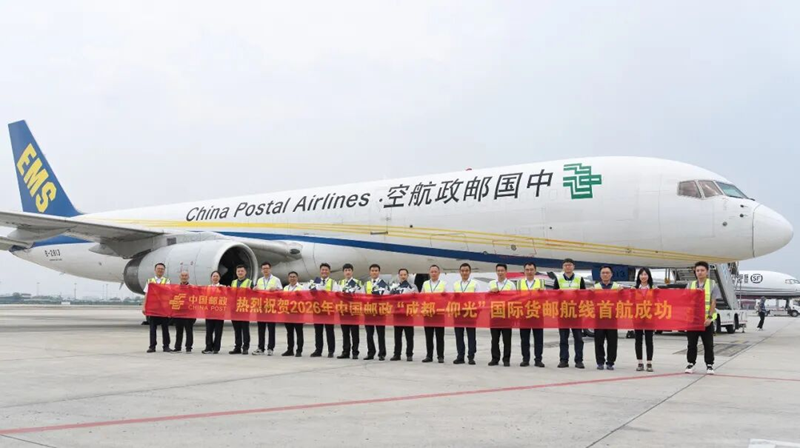
(Photo by Dai Jie)
It is learned that the cargo items carried on the route are clearly categorized and highly complementary in nature. The outbound flights mainly transport high-quality Chinese goods such as cross-border e-commerce products, local intelligent manufacturing equipment from Sichuan, and machinery parts, helping manufacturing industries in Sichuan-Chongqing region go global. The return flights focus on carrying local high-quality resources such as fresh products from Myanmar, tropical fruits and specialty crafts, enriching the supply of the consumer market in the Southwest China. In the initial stage of operation, the route is scheduled to fly twice a week, on Tuesday and Sunday respectively, with a one-way cargo capacity of up to 25 tons. After the operation stabilizes, the frequency will be increased to three flights per week to continuously improve the cargo throughput capacity.
The opening of the Yangon all-cargo route is a key initiative for China Postal Express & Logistics Co., Ltd. to deeply cultivate its market in Southwest China and expand into the Southeast Asian freight market. It also makes a significant step in enhancing the the air cargo network in Southeast Asia. As early as December 2024, China Postal Airlines successfully opened the Chengdu-Dhaka (Bangladesh) all-cargo route. The launch of the new route further densifies and expands China Post's air freight layout in Southeast Asia, significantly improving the cross-border logistics accessibility of Southwest China.
Relevant personnel in charge of China Post stated that they will further plan to open an international postal route directly connecting Chengdu to Myanmar in the future. After the opening of the corridor, it will not only build a more time-efficient and better-served material transportation bridge for overseas Chinese-funded enterprises and overseas Chinese, but also rely on the full-network logistics resources to provide inclusive cross-border mail transportation services, so as to comprehensively help Sichuan build an inland open strategic highland.
As the largest city and economic center of Myanmar, Yangon is a core hub node for Sichuan to connect with Myanmar and the Southeast Asian markets. In recent years, the economic and trade cooperation between Sichuan and Myanmar in the fields such as textile processing trade and agriculture has continued to deepen with remarkable vitality. Previously, specialty products such as silk from Sichuan-Chongqing region were mainly exported via land routes through border ports in Yunnan. The transportation link was relatively long, leading to slow turnover efficiency, and placing relatively significant pressure on enterprises in terms of inventory preparation and management.
The opening of the new route completely breaks the original logistics bottleneck, enabling goods in Sichuan-Chongqing region to reach Yangon directly in 3 hours, significantly shortening the cross-border transportation cycle, effectively reducing enterprises' logistics and inventory costs, and comprehensively improving the response efficiency of the regional cross-border supply chain. On the import side, relying on the abundant aquatic resources in Yangon and its surrounding areas, cost-effective fresh ingredients such as mud crabs and lobsters can quickly arrive in Chengdu by air, and be timely delivered to farmers' markets and fresh e-commerce platforms in Southwest China, enriching the variety of food on residents' dining tables. Currently, there are 6 cargo flights operating from Chengdu Shuangliu International Airport to Yangon every week; and the collection, distribution and radiation effects of the aviation hub continues to be released and amplified.
In recent years, with the support of multiple parties including CHENGDU CUSTOMS DISTRICT P.R.CHINA, provincial and municipal port logistics authorities, and the Airport Group, Shuangliu District has been deeply cultivating the aviation logistics industry, continuously optimizing the port business environment, increasing the density of international cargo routes, and improving the logistics supporting system, so as to promote the steady improvement of the international cargo capacity of the Shuangliu Airport. According to the data, the Shuangliu Airport added a new international cargo route to Istanbul, while increasing the frequency of multiple international cargo routes to Amsterdam, Glasgow and other destinations. In the first half of the year, the total cargo and mail throughput reached 348,000 tons. Specifically, the international and regional cargo and mail throughput reached 165,000 tons, with a year-on-year increase of 11.5%, accounting for 47% of the total airport cargo and mail throughput, and representing a 4% increase compared to the same period last year. The airport's cargo transportation continues to show a positive trend towards internationalized, specialized and large-scale development.
By leveraging its own air transport capacity to open the Yangon route, and with the subsequent launch and layout of the international postal route, China Post will further consolidate the advantage of Sichuan's air logistics corridor connecting Southeast Asia, injecting strong impetus into the upgrading of regional cross-border trade, cross-border industrial cooperation and the construction of the inland open gateway. (Li Xiaolan, Zhao Yin, Wu Qiong)
Translated by: Zhang Feng from Jinan University
Reviewed by: Mao Min from Beijing Yooyi Culture and Media Com., Ltd.